By 2026, the most common trend among retail traders seeking large capital without risking their savings has been securing Funded Accounts. Prop firms have shifted their focus largely on discipline, consistency, and risk control factors rather than purely looking at profit numbers.
Hence, correctly grasping the concept of day trading for beginners becomes a bigger focus. Actually, looking at it from a psychological angle, traders fail not because of lack of strategy but because they don’t know how to apply simple rules with discipline in a real evaluation environment.
Gaining access to a funded account is not a race one should win but a game of survival, structure, and consistency.
Understanding Day Trading for Beginners in a Funded Environment
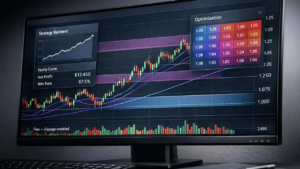
On the subject of day trading for beginners, a majority of people associate it with taking several trades every day and chasing speedily earned profits. Successful day trading, however, is a highly selective and controlled process.
Day trading or intraday trading involves simultaneously opening and closing positions within a single trading day. Not holding any overnight positions means that one is less exposed to unexpected market risks. Nevertheless, this trading style must be carefully controlled with Funded Accounts since each trade impacts drawdown limits.
Fast forward to 2026, those traders who will figure out how to make money are not the ones who trade the most, but those who trade the best setups with discipline.
How Funded Accounts Actually Work
Getting a Funded Account means passing through an evaluation process where the trader’s proficiency in risk management and consistency is put on test.
Prop firms implement strict rules such as setting a maximum drawdown limit, a daily loss limit, and a minimum number of trading days. These rules are designed to eliminate emotional and indisciplined traders.
So if you are learning day trading for beginners, it means that you need to change your priority from earning quick money to capital preservation and rule compliance.
If you don’t understand this system then even profitable traders end up failing evaluations.
Building a Structured Trading Mindset
Very often, beginners try entering financial markets with high emotional expectations wherein they even think that every trade should definitely result in a profit.
However, the truth is that trading involves losses as well and losses have to be managed properly instead of being emotionally ignored.
The right psychology when applying day trading for beginners is to treat each trade as a probability and not a fixed outcome. You don’t have to be right with every single trade. What is important is to follow your strategy with consistency over an extended period.
It is this mind-set that helps traders make to the point of passing their assessments.
Risk Management as the Core Strategy
Out of all things, risk management is what actually helps you to have a Funded Account.
It’s the second biggest factor after the fact that most of the time, operators not only have bad entries but also commit the biggest error by risking too much on a single trade. A single impulsive decision can undo days of hard work.
Such a way of thinking when learning how to start day trading for beginners means that you have to set your limit, control your loss, and choose your stop loss and position size before the trade starts.
That will lead to you being in the driver’s seat and subsequently, trading decisions will become much less emotional after that.
Selecting High-Probability Setups
Within a Funded Account, quality of trading is more important than quantity of trading, literally.
Newbies usually make the mistake of thinking that more trades will result in more profits but the truth is overtrading is a major cause of inconsistency and drawdown violations.
Traders going for the beginner’s day trading strategies should try only to make trades in those market situations where structure, timing, and confirmation are all aligned.
Highly successful traders in 2026 are very discerning. They do not trade just for the sake of it but wait for markets to present opportunities.
Execution Discipline in Live Trading
Execution is the area that most traders lose their grip. It doesn’t matter how good your analysis is if your execution is bad it will just lead to losses.
Execution, in a Funded Account in particular, has to be not only precise but also rule-oriented. Premature entry or entry without presence of confirmation is very likely to lead to unnecessary drawdown.
A trader practicing day trading for beginners first thing must get used to is the waiting game for the confirmation of a trade before the entry. Such a move very well may reduce emotion-driven entries and help with consistency enhancement.
Execution of good quality focuses on the virtue of patience rather than the one of speed.
Emotional Control in Trading Sessions
The list of challenges in day trading is topped by emotions undoubtedly. Fear of missing out, getting upset after loss, and feeling overconfident after a win all in one way or another throw consistency off.
Within a Funded Account, if emotions run wild, it will not take long for such emotional mistakes to result in rule violations and failing evaluations.
Learning day trading for beginners struggling with understanding emotional control is, in this case, like learning how to keep calm even while under pressure, how to avoid revenge trading, and how to stop after reaching a certain point according to rules.
Going into the year 2026, emotional discipline is, alongside technical analysis, recognized as a very important factor by which one can judge.
Common Mistakes That Stop Traders from Passing
Quite a few traders fail in funded challenges as a direct result of repeating very basic mistakes.
Besides increasing risk after losses, constant changing of strategies, and entering trades without proper confirmation, some also trade simply out of boredom rather than waiting for setups.
A lot of these types of behaviors inside a Funded Account are what put a trader at risk because they easily lead to breaking consistency rules.
If day trading for beginners is your guide, the aim is to get rid of randomness from trading decisions completely.
Building Consistency Over Time
Consistency is that particular one changing factor which makes initial traders professional ones with funded accounts.
A Funded Account is not a divine right prize of a single day. It is the result of the accumulation of disciplined executions repeated over time.
Only by using a well-performing, day trading for beginners strategies, can the traders be trained to do one and the same structured, step-by-step process daily: analyze, wait, execute, manage risk, and stop when necessary.
The outcome of this type of instilling process is in a more steady and emotionally stable trader.
Conclusion
The year 2026 will be a year when having a Funded Account will be less about high volume trading but more about self-control, being patient, and sticking to structured execution.
If you understand day trading for beginners the right way you are the first person to be able to avoid emotional mistakes and, instead, concentrate on long-term consistency.
Those traders who end up succeeding are not necessarily the ones who trade most; rather these are the ones who manage risk well and strictly follow their plan day in and day out.
All in all, it is the mastery over consistency and control that junior traders become funded ones.